In late October, the WasteSync team exhibited at Procurex Scotland at the SEC Glasgow. As the only dedicated Digital Waste Tracking (DWT) software provider on the exhibition floor, we spent the day in back-to-back discussions with local authority procurement leads, municipal waste strategy managers, public-sector framework specialists, and private-sector receiving sites.
With mandatory Digital Waste Tracking already live across England, Wales, and Northern Ireland as of 1 October 2026, the attention of Scottish operators is fixed firmly on 1 January 2027, when Phase 1 of the mandate takes effect for permitted and licensed waste receiving sites under SEPA.
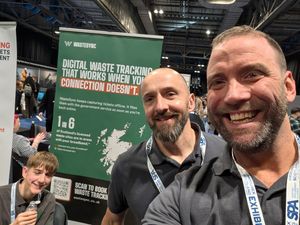
Across more than 50 conversations on the stand, it was clear that the discussion in Scotland has moved past abstract policy. Procurement teams and site operators are now focused on the practical realities of implementation: how to capture roughly 30 Schedule 1 data points per load, meet the statutory reporting deadline (close of the second working day after receipt), and maintain gatehouse throughput without costly hardware replacements.
Four operational themes dominated our conversations in Glasgow.
1. Gatehouse Continuity Cannot Depend on a Live Cloud Connection
The primary concern raised by both rural local authorities and private quarry and transfer station operators is connectivity at the operational edge.
In theory, cloud-based compliance reporting sounds straightforward. In practice, municipal depots, aggregate quarries, and rural waste transfer stations frequently sit in cellular dead-spots or rely on fragile site broadband. Even where site connectivity is strong, central government APIs can experience intermittent outages, rate limiting, or schema updates.
When a 40-tonne Artic is sitting on a weighbridge in pouring rain, the gatehouse operator cannot wait for a synchronous cloud API response before printing a ticket and lifting the barrier. If the software locks up when the internet drops out, trucks queue onto the public highway, site throughput stalls, and operators are forced back onto manual paper workarounds that create double-handling for back-office staff.
To protect site operations, compliance infrastructure must be built offline-first:
- Local Edge Capture: Weights, EWC codes, carrier licence validations, and movement records must be captured locally in milliseconds at the weighbridge or tablet kiosk.
- Immediate Barrier Release: The vehicle ticket prints and the barrier lifts without waiting for an external server handshake.
- Automated Regulation 6 Resilience: Under Regulation 6 (System Outages), operators must maintain a record within the normal deadline and upload it within seven days once central systems stabilise. WasteSync cryptographically timestamps and queues payloads locally at the edge, automatically syncing and reconciling with the central DEFRA/SEPA API in the background the moment connectivity returns.
2. Middleware Over "Rip-and-Replace" IT Projects
Public-sector budgets are under intense scrutiny, and private operators are equally reluctant to write off working capital equipment. One of the strongest messages from procurement officers at Procurex was that councils do not have the appetite, budget, or runway for 18-month legacy IT replacement projects ahead of a January statutory deadline.
Furthermore, during Phase 1 of the rollout, statutory Duty of Care (Section 34 of the Environmental Protection Act 1990) paper Waste Transfer Notes and Hazardous Waste Consignment Notes must still travel with the load and be retained alongside digital submissions.
Operators need a lightweight middleware layer that bridges their existing physical infrastructure directly to the regulator:
- Direct Hardware Integration: Connecting straight into existing legacy weighbridge indicators (such as Avery Weigh-Tronix or Precia Molen systems) without replacing the scales or cab hardware.
- Dual-Running Certainty: Supporting parallel paper ticket generation and automated digital API submission in a single gatehouse workflow, proven through our live municipal dual-running pilot with Dundee City Council.
- Zero Operational Disruption: Deployed via high-contrast, industrial progressive web interfaces designed specifically for bright cab and gatehouse environments, requiring minimal staff retraining.
3. Authoritative Spatial Data as a Compliance Safeguard
As waste regulation tightens ahead of Phase 1 in Scotland (January 2027) and the UK-wide Phase 2 expansion to waste carriers, brokers, and dealers (October 2027), verifying the physical origin and receiving boundary of waste movements is becoming critical to audit readiness.
Supported by the Geovation Scotland programme (delivered by Ordnance Survey and Registers of Scotland), WasteSync embeds authoritative geospatial datasets directly into the compliance workflow rather than relying on approximate consumer GPS radii:
- OS MasterMap Topography Layer: Establishes exact polygon geofences around permitted site boundaries and weighbridge gates, ensuring digital records accurately reflect licensed receiving areas.
- OS AddressBase & UPRN Verification: Pinpoints verified waste origin locations at the point of capture, stripping out ambiguous free-text addresses that trigger downstream audit exceptions or require manual corrections under Regulation 7.
4. De-Risking Public and Private Procurement
For local authority procurement teams and tier-one contractors, technical capability is only half the equation; supplier assurance and data security are equally critical. When procuring software that handles statutory environmental filings and connects to council networks, buyers need certainty that a provider is ready for immediate deployment.
At Procurex Scotland, conversations moved quickly from initial discovery to framework and deployment planning because the core compliance foundations are already in place:
- DEFRA Production Approved: WasteSync has passed all 14 out of 14 DEFRA Production Approval Tests (PAT) for the UK Digital Waste Tracking Service and is listed on the official GOV.UK compatible software provider directory.
- Cyber Essentials Accredited: Certified security controls across our corporate and engineering operations.
- UK Data Sovereignty: Provisioned on Google Cloud Platform infrastructure locked strictly to the
europe-west2(London) region, with private networking and row-level security ensuring full GDPR compliance and auditability.
Preparing Your Sites for 1 January 2027
With less than two months until the Scottish receiving-site mandate takes effect, the window for pre-market engagement and operational testing is narrowing. Whether you are a local authority preparing a procurement specification, an existing waste infrastructure supplier looking to embed DWT compliance into your contract delivery, or a private operator running transfer stations and quarries, the transition does not require tearing out your existing gatehouse setup.
Thank you to the Geovation Scotland team and everyone who visited the WasteSync stand at the SEC Glasgow.
Book a Technical Walkthrough
If we missed you at Procurex Scotland and you want to see how WasteSync keeps weighbridges moving while automating SEPA and DEFRA compliance, contact our team at alastair@wastesync.co.uk or visit www.wastesync.co.uk to arrange a site assessment or live demonstration.