Recently, we spoke with the owner of a Scottish construction firm: a growing SME with a £3M turnover, 26 employees and multiple active sites across rural and semi-rural locations. Like many in the industry, he knew changes to waste legislation were coming, but the specifics were hazy.
To get up to speed, he turned to some popular AI research tools. The summary he received? "Digital waste tracking is primarily a requirement for waste receiving sites and facilities, not construction firms. Waste producers have until October 2027 to comply."
Relieved, he put waste compliance at the bottom of his 2026 priority list.
Unfortunately, this is a common and dangerous misconception affecting hundreds of UK construction SMEs right now. While the AI wasn't technically wrong about the legal mandate dates, it entirely missed the practical reality of how the construction supply chain operates.
Construction firms looking at the DEFRA waste tracking construction timeline think they have 18 months to prepare. In reality, because of how the supply chain interacts, they have fewer than eight.
Here is the full story of the digital waste tracking construction sites mandate, why waiting until 2027 is a strategic error and what civil engineering, demolition and construction contractors need to do right now.
"Construction sites think they have until October 2027 to adopt digital waste tracking. In reality, the supply chain will force their hand by January 2027. Waiting means scrambling."
The Two-Phase Rollout Explained
To understand why the timeline is deceptive, we first need to look at how DEFRA and the UK environmental agencies (the Environment Agency in England, SEPA in Scotland and NRW in Wales) are rolling out the Digital Waste Tracking (DWT) service.
The implementation is broken down into two distinct phases, targeting different ends of the waste journey.
Phase 1: The Receiving Sites
October 2026 (England) / January 2027 (Scotland & Wales)
In Phase 1, the mandate hits the "end of the line": the waste receiving facilities, transfer stations, recycling centres and landfills.
Under the new regulations, these facilities will be legally required to maintain digital records of all waste received. They must submit this data to the central DEFRA system, creating a Unique Movement Reference (UMR) for every single load. Crucially, they must upload this digital data within 48 hours of the waste arriving at their gates.
Common Misconception
“Construction sites aren't mandated until October 2027, so we have time to wait and see what others do.”
Reality: Your carriers and receiving facilities will demand digital data from January 2027. Waiting means scrambling to adopt whatever system they force upon you, likely losing control of your own compliance data in the process.
Phase 2: Waste Producers, Carriers and Brokers
October 2027 (UK-Wide)
This is the date most construction managers have circled on their calendars. Phase 2 is when the legal mandate extends to the producers of waste (your construction sites) and the carriers who transport it. By October 2027, creating a digital Waste Transfer Note (WTN) before waste leaves your site becomes a strict legal requirement.
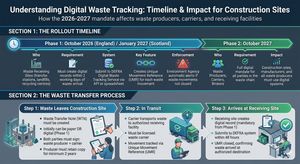
Visual timeline showing the Phase 1 (Receiving Sites - Oct 2026/Jan 2027) and Phase 2 (Producers - Oct 2027) rollout.
The Existing Legal Baseline
It is vital to remember that while the digital format is new, the underlying legal requirements are not. Construction sites are already legally obligated under the Environmental Protection Act 1990 (Duty of Care) to:
- Create an accurate Waste Transfer Note (WTN) when waste leaves the site.
- Ensure both the producer and the licensed carrier sign the WTN.
- Retain a copy of these records for a minimum of two years.
The transition to digital doesn't invent these rules; it simply makes enforcing them immediate and unavoidable.
Why Construction Sites Can't Wait Until 2027
If the law doesn't explicitly target construction sites until October 2027, why the urgency? Because waste doesn't exist in a vacuum. Construction waste management relies on a tightly integrated supply chain of carriers and receiving facilities.
When you look closely at construction waste regulations 2027, the practical impacts hit your site much earlier. Here is why the October 2027 date is a myth.
1. The Supply Chain Reality
Imagine it is February 2027. A skip lorry arrives at your site in Northern England to collect mixed construction waste.
The facility where that skip is headed is now under the Phase 1 mandate. They are legally required to submit digital records of that waste to the government within 48 hours.
Do you think that modern, high-volume waste facility wants to receive a crumpled, mud-stained, handwritten paper WTN from your site supervisor, only to pay an administrative staff member to manually re-key that data into the government portal before the 48-hour deadline expires?
Absolutely not.
Receiving facilities will refuse paper notes, or they will charge punitive administration premiums for accepting them. To stay competitive and keep their facility clients happy, the waste carriers (the skip companies and hauliers) will upgrade their own operations to be entirely digital by late 2026 or early 2027.
When that skip driver arrives at your site in February 2027, they will not hand you a paper triplicate pad. They will hand you a tablet. They will demand digital WTNs immediately, pulling you into the digital system months before your legal deadline.
2. The Control Problem
"When your supervisor signs a carrier's tablet, you are using their system. You have zero control over the data being submitted to the government with your company's name attached to it."
This is the biggest operational risk.
When your supervisor signs a carrier's tablet, you are using their system. You have zero control over the data being submitted to the government with your company's name attached to it.
- Do you get an automatic, easily searchable digital copy for your records? Often, no. It might get emailed to a generic inbox and lost.
- Do you have proof of the exact EWC (European Waste Catalogue) codes assigned to that load?
- Do you have a reliable audit trail to feed back into your Site Waste Management Plans (SWMPs)?
If a dispute arises (for instance, the receiving facility claims the skip contained hazardous materials or weighed three tonnes more than expected) you have no independent evidence. You are entirely reliant on the carrier's digital records.
Furthermore, environmental agencies are increasing their enforcement actions. The Environment Agency currently charges £118 per hour for regulatory interventions and investigations. If they audit your site and you cannot instantly produce your WTNs because they are locked inside various different carriers' proprietary systems, you are the one facing the fines, not the carrier.
Scotland-Specific Timeline Note
Operating across borders? Be aware of the fragmented rollout:
- England receiving sites: October 2026
- Scotland receiving sites: January 2027
- All waste producers (UK-wide): October 2027
If you operate sites in both Carlisle and Dumfries, your supply chain will start demanding digital compliance at different times. Uniformity across your operations is essential.
3. The Compliance Gap
Beyond supply chain pressures, paper systems create massive compliance gaps that the government is actively looking to close.
Construction sites routinely struggle with accurate EWC codes construction tracking. For example, defaulting to 17 09 04 (mixed construction and demolition wastes) is common, but regulators are increasingly scrutinizing this to ensure hazardous materials aren't being hidden or improper sorting isn't taking place.
A paper system allows for scribbles, missing fields and illegible signatures. Digital systems enforce completeness. They require the correct EWC codes, accurate carrier license numbers and proper signatures before the UMR can be generated.
If you wait until October 2027 to learn how to manage these digital compliance gates, your site operations will grind to a halt the first time a load is rejected due to a data error.
The Two Paths Forward
Let's return to our scenario in early 2027. The mandate has hit the receiving sites. The waste carrier arrives at your muddy, remote site to collect a load. You have two choices for how this plays out.
Path A: The Reactive Approach
You haven't prepared. The carrier arrives with their digital system. Your site supervisor, standing in the rain, is asked to sign a screen they can barely read.
The Result: The waste leaves, but your compliance is compromised. You have no immediate retained copy. You have no control over whether the carrier categorized the waste correctly. If the carrier's tablet loses signal (a common occurrence in rural areas), the driver might refuse to take the load, delaying your site operations. If an EA or SEPA inspector asks for your records next week, you have to spend hours chasing the carrier's head office for an email PDF.
Path B: The Proactive Digital System
You spent late 2026 implementing your own digital WTN construction process.
The Result: When the carrier arrives, your site supervisor uses your company's chosen compliance platform. They generate a digital WTN, selecting pre-approved EWC codes that match your Site Waste Management Plan. The carrier signs your system.
An automatic copy is instantly retained in your cloud storage, fulfilling your 2-year legal requirement automatically.
Because you chose a platform with offline waste tracking construction sites capabilities, it doesn't matter that your rural Scottish site has no 4G signal. The app captures the signatures offline and securely syncs the data to the DEFRA portal the moment the supervisor drives back into a coverage zone.
You keep control, you stay compliant and the site keeps moving.
What Construction Firms Should Do Now
The window to prepare is closing, but there is still time to get ahead of the supply chain shift. Here are seven practical steps civil engineering firms, demolition contractors and construction SMEs should take immediately:
- Audit your current process: How does waste currently leave your sites? Are you entirely paper-based? Who physically fills out the WTNs: the site supervisor, a labourer, or the office staff?
- Understand your site connectivity: Map out your active and upcoming sites. Do you operate in rural areas, deep excavations, or remote locations with patchy cellular signal? If so, an "offline-first" digital solution is not a luxury; it is a fundamental requirement.
- Calculate your waste volumes: Track how many waste movements occur per week or month. This data will help you evaluate the ROI of different digital platforms.
- Identify your compliance champions: Decide who will own this transition.
- Evaluate digital options: You will have the option to use the free government portal, but specialized B2B platforms like WasteSync offer better site-side controls.
- Plan a pilot test: Pick 1-2 sites with reliable supervisors and run a digital pilot alongside your paper system.
- Target Q3/Q4 2026 for implementation: Aim to have your systems fully operational before the January 2027 deadline hits.
Quick Win Tip
If you're unsure where to start, audit one high-volume site for a single week. Count the exact number of waste movements, note any internet connectivity issues on site and time how long supervisors spend managing paper WTNs. This raw data is the foundation of your digital strategy.
The Bottom Line
When it comes to waste compliance construction sites UK, the calendar is misleading.
Yes, the strict legal mandate for waste producers is October 2027. But the practical impact timeline begins in late 2026 and January 2027 when the waste supply chain (the receiving facilities and the carriers) goes entirely digital.
Those who prepare early will get a smooth transition, solid compliance and turn waste management from an administrative headache into an advantage.
Need help with the transition?
If you're managing construction waste across multiple sites, particularly in rural Scotland or Northern England where offline capability is critical, we'd be happy to discuss how digital waste tracking will impact your specific operations.
At WasteSync, we specialize in offline-first digital tracking designed for the realities of the physical worksite.